SeaWorld Stock Documents Admit Risk of 'Injuries or Death' to Employees and Visitors
As SeaWorld prepares to become a publicly traded company, it has made some confessions that are sure to give pause to potential investors. In a prospectus that it submitted to the Securities and Exchange Commission, SeaWorld admits that "[a]ll animal enterprises involve some degree of risk" and that at SeaWorld, specifically, "injuries or death, while rare, have occurred in the past."
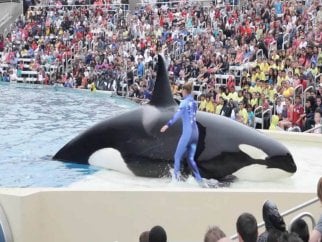
SeaWorld cites the 2010 killing of trainer Dawn Brancheau by an orca at SeaWorld Orlando and acknowledges that an inspection following Brancheau's death by the U.S. Department of Labor's Occupational Safety and Health Administration "resulted in three citations concerning alleged violations of the Occupational Safety and Health Act and certain regulations thereunder."
Most tellingly, SeaWorld admits that Brancheau's death garnered an enormous amount of negative publicity and was not an isolated incident and that "similar events that may occur in the future may harm our reputation, reduce attendance and negatively impact our business, financial condition and results of operations." Considering SeaWorld's long history of injuries and deaths from dangerous interactions between trainers and marine mammals, including more than 100 incidents of orca aggression, we'd say that's a safe bet.
Potential investors, beware: Buying stock in SeaWorld might come back to bite you.
December 11, 2012
PETA Files Complaint in Behalf of Injured Dolphin at SeaWorld
Does this sound like déjà vu to you? A weekend visitor to SeaWorld in San Antonio has sent PETA disturbing photographs of a dolphin who appears to be missing a chunk of flesh from his or her lower mandible. The injury is strikingly similar to the one sustained by an orca named Nakai at the San Diego SeaWorld just a few months ago. Just as we did for Nakai, PETA has filed a complaint with the U.S. Department of Agriculture (USDA) and requested an investigation into the cause of the dolphin's injury.
In Nakai's case, the USDA listed the orca's injury as being caused by a recessed track that holds gates that separate two of the tanks. Another injury to another animal, also caused by SeaWorld's dangerous enclosures, would demonstrate a clear violation of the Animal Welfare Act, which states that facilities must be structurally sound and free from objects, projections, or edges that may cause injury and that all animals must be handled in a manner that does not cause physical harm.
But even without injurious enclosures, SeaWorld still harms marine mammals by robbing them of everything that is natural, pleasant, and important to them, such as living in family pods and swimming up to 100 miles a day in the open ocean.
And SeaWorld sentences animals to an early grave: Orcas, for instance, can expect to live an average of 30 to 50 years in the wild, and some live as long as 90 years. The median age for orcas in captivity is only 9 years. The debilitating stress of captivity weakens the animals' immune systems. In fact, some other weekend visitors to SeaWorld San Antonio reportedly told employees about a shark who was lying belly-up in a tank and appeared to be dead.
PETA Asks USDA to Investigate After Child Injured by SeaWorld Dolphin
Following the release of video footage showing a dolphin biting the hand of a young girl at SeaWorld Orlando, PETA submitted a complaint to the U.S. Department of Agriculture (USDA) requesting an investigation to determine whether the incident stemmed from Animal Welfare Act (AWA) violations.
Risky Business
The video shows 8-year-old Jillian Thomas feeding fish to the dolphin as part of the Dolphin Cove attraction at the park. When she raises up the paper carton used to hold the fish, the dolphin surges up to grab it, biting Jillian's hand in the process. The girl sustained puncture wounds to her hand, and the dolphin may have ingested the entire paper carton.
AWA regulations require that animal attractions have "sufficient distance and/or barriers between the animal and the general viewing public so as to assure the safety of animals and the public." PETA has also asked the USDA to ensure that if the dolphin did ingest the carton, the animal receive proper veterinary care, per AWA requirements.
A similar incident occurred in 2006, when a dolphin's mouth had to be pried open to free a 7-year-old boy's hand. It was the second time in three weeks that a child had been bitten at the attraction, but SeaWorld refused to change anything.
Amusement or Abuse?
These episodes provide further reminders (as if more were needed) of how little SeaWorld is concerned with safety in its parks—except, of course, for the protection of its ticket sales. Not only has its unwillingness to take necessary precautions caused children to be harmed, it's also resulted in severe injuries and even the deaths of its trainer and the animals it holds captive.
Even if SeaWorld implemented every safety procedure possible, though, life in captivity would still be miserable for the dolphins, orcas, and other animals imprisoned in its parks. Deprived of their families, social lives, and freedom of movement, these smart, sensitive beings grow increasingly frustrated, contributing to the risk for sudden, violent behavior.
Catch Kindness, Free Animals
Unlike SeaWorld, young Jillian is showing compassion—according to an Associated Press article, she prayed for the dolphin who bit her and hopes the animal "didn't get sick from eating the paper carton."
After visiting SeaWorld and taking photographs of Nakai's injury (two of which are shown below), Dr. Ingrid N. Visser, founder and principal scientist of the Orca Research Trust, found that there are "puncture marks that match orca teeth spacing," which "is a clear indication that an altercation between the orcas was involved." The puncture marks in question can be seen at the bottom right of the wound in the first photo below:
Following a serious and gruesome injury to an orca in an avoidable attack, PETA has submitted a complaint asking the U.S. Department of Agriculture to take disciplinary action against SeaWorld for housing orcas incompatibly in violation of the Animal Welfare Act (AWA).
As you can see in these disturbing photographs, Nakai, an 11-year-old male orca at SeaWorld in San Diego, sustained a laceration so significant that, as a whistleblower said, "a dinner plate-sized chunk of his lower mandible [has been] sheared off, exposing underlying tissues, and bone." The flesh cut from him "was big enough and intact enough for SeaWorld to retrieve it from the bottom of the pool."
According to the whistleblower's report to journalist Tim Zimmermann, Nakai's injury was a result of "a major altercation" between Nakai and two other orcas, Keet and Ikaika. The AWA makes it clear that "marine mammals that are not compatible must not be housed in the same enclosure." Yet SeaWorld parks have a long history of housing incompatible orcas from widely divergent groups together in enclosures—and the result has been stress, agitation, aggressive and bloody raking, serious injury, and death.
What You Can Do
It's clear that SeaWorld can't be trusted to make the safety and well-being of marine animals its top priority. Please don't ever visit SeaWorld (or any other marine-mammal park)—and tell company executives why you won't support the abuse of Nakai and the other intelligent, complex animals they've imprisoned and enslaved.
Written by Jeff Mackey
August 3, 2012
Shocking Video of SeaWorld Attack
The release of a video showing Kasatka, a wild-caught orca enslaved at SeaWorld, exploding in extreme frustration at trainer Ken Peters in front of visitors to the theme park is sending shockwaves of outrage and dismay through the media and the public over the appalling pressures of captivity on orcas and other wild marine mammals—and the danger to those who come into contact with them.
As David Kirby describes in his book Death at SeaWorld, when Kasatka heard her calf's distress calls for her from another tank, she dragged Peters underwater repeatedly, shaking him about before the stunned audience. Eventually gaining his freedom, Peters required surgery for his injuries. But SeaWorld ignored the risks, permitting the perilous situations to continue.
This video footage was previously shown during the Secretary of Labor v. SeaWorld of Florida LLC trial, which resulted from the horrific death of SeaWorld trainer Dawn Brancheau during a disturbingly similar episode involving another captive orca, Tilikum. Judge Ken Welsch, who called the video "chilling," held SeaWorld liable for permitting hazardous interactions between humans and the huge, dangerously stressed animals.
What You Can Do
Please join PETA in asking The Blackstone Group—the company that owns SeaWorld—to release its animal captives into sanctuaries. And if you know people who are planning a trip to SeaWorld, encourage them to visit PETA's new website, SeaWorldOfHurt.com, to learn what kinds of cruelty their dollars would support.
July 27, 2012
Bestselling Author Blows Lid Off SeaWorld
The latest must-read from investigative journalist and New York Times bestselling author David Kirby is Death at SeaWorld, which meticulously chronicles the miserable lives and deaths of captive orcas at the marine park, and how the park also puts employees at risk. From the tragic death of trainer Dawn Brancheau in 2010, to many other less-publicized violent incidents, Kirby details the deeply rooted culture of cruelty and culpability at SeaWorld.
Although not originally conceived as a slam of the theme park (multiple attempts by the author to get SeaWorld's input were rebuffed), the book makes it clear that confining animals who have evolved over millions of years to swim the vast open oceans leads to aggression, depression and premature death.
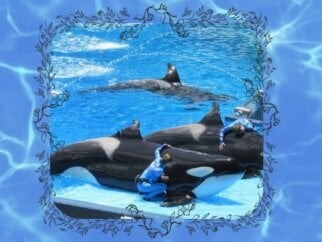
Kirby reports that while no serious attack by a wild orca on a human has ever been recorded, SeaWorld's own corporate incident logs contain reports of more than 100 incidents at its parks. Orcas have pulled trainers into the water, held them at the bottom of the pool, head-butted them, slammed into them, and breached on top of them.
As Ric O'Barry, who was part of PETA's ground-breaking lawsuit against SeaWorld, puts it, "Death at SeaWorld outlines in grim detail just how bad captivity is for orcas and other marine mammals."
When an individual is removed from his or her home by force, imprisoned, made to work, and forever denied their freedom, it's called "slavery." In October 2011, PETA filed a lawsuit against SeaWorld in behalf of five wild-captured orcas seeking a declaration that these five orcas are slaves and subjected to involuntary servitude in violation of the 13th Amendment to the U.S. Constitution. Joined by three orca experts and two former SeaWorld trainers, PETA's lawsuit asserts that the conditions under which these orcas live constitute the very definition of slavery.
The plaintiffs in the case, Tilikum, Katina, Kasatka, Ulises, and Corky, were captured and taken from their ocean homes and families and are confined to the equivalent of concrete bathtubs, where they are forced to earn money for SeaWorld by performing for customers' entertainment. They have also been turned into virtual breeding machines in order to provide more performers for SeaWorld's cruel shows.
The case sought the release of all five orcas to a more appropriate environment, such as a coastal sanctuary. Protected sea pens would allow orcas greater freedom of movement as well as the opportunity to see, sense, and communicate with their wild cousins and other ocean animals; to feel the tides and waves; and to engage in the behaviors that they've long been denied. Eventually, they could be released into the ocean to be reunited with their pods.
The keen legal minds behind the revolutionary lawsuit include that of Jeffrey Kerr, general counsel to PETA. Kerr has defended animals for 16 years and also established and serves as general counsel to PETA's international affiliates around the world.
Renowned civil rights attorney Phil Hirschkop—who argued and won the landmark Loving v. Virginia case, which declared unconstitutional the laws banning interracial marriage—also joined the legal team.
"Forty years ago I fought for the fundamental right of people to marry the person of their choosing, regardless of race," says Hirschkop. "Now I'm fighting for these orcas' fundamental rights to be free from enslavement regardless of their species." PETA's briefs cited more than 200 years of U.S. Supreme Court precedent, including such landmark cases as Dred Scott, Brown v. Board of Education, and Loving, to establish that the orcas' species does not deny them the right to be free under the 13th Amendment and that long-established prejudice does not determine constitutional rights.
This case created buzz in the news and scholars have expressed support for the case. Harvard law professor and constitutional scholar Laurence H. Tribe said, "People may well look back on this lawsuit and see in it a perceptive glimpse into a future of greater compassion for species other than our own."
On February 8, Judge Miller ruled that the 13th Amendment doesn't apply to nonhumans. However, women, children, and racial and ethnic minorities were once denied fundamental constitutional rights that are now self-evident, and that day will certainly come for the orcas and all the other animals enslaved for human amusement. PETA will continue to pursue every available avenue to fight for these animals. You can make a difference right now by refusing to buy a ticket to SeaWorld and by talking to parents and grandparents about the miserable existence that animals who live and die in barren, cramped cement tanks endure.